CogAT 97th Percentile and Gifted Placement in Grade 7: Harsheen's Story
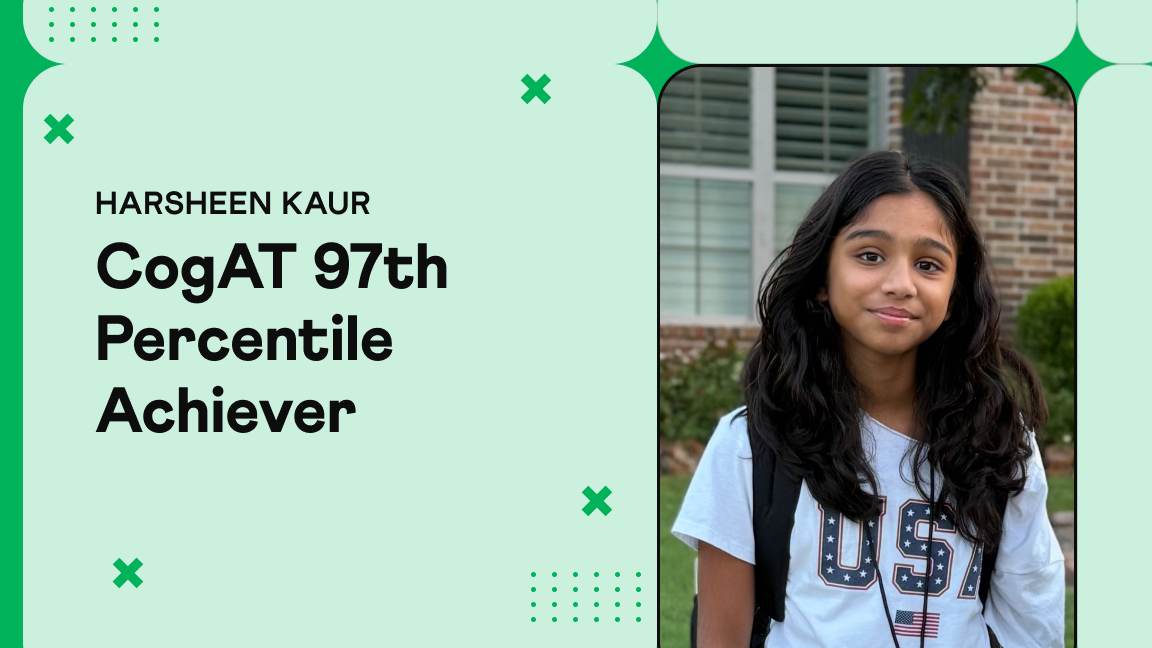
Harsheen Kaur scored in the 97th percentile on the CogAT and qualified for the Gifted and Talented program in Grade 7. Two years with Cuemath turned a student who was uncomfortable with math into one who stays ahead of her class.
Some parents worry about grades. Others worry about something harder to measure. For one family in the US, the concern was not that their daughter was falling behind. It was that she could do the work but did not feel confident doing it. There is a difference between a child who gets through math and a child who feels at home in it. Her parents wanted the second.
Two years later, Harsheen Kaur scored in the 97th percentile on the CogAT (Cognitive Abilities Test), qualifying for the Gifted and Talented program in her school district. She now consistently stays ahead of her math class. The ability was always there. What changed was how she felt about using it.
This is the story of Harsheen.
Meet Harsheen Kaur
- Grade: 7
- Country: United States
- Tutor: Naman Jain
- With Cuemath Since: 2+ years
- CogAT Score: 97th Percentile
- Program Placement: Gifted and Talented
What the CogAT Actually Measures
The Cognitive Abilities Test (CogAT) is one of the most widely used assessments in the United States for identifying students for gifted and advanced programs. Unlike school tests, it does not measure memorised content. It measures how a student reasons across three areas: verbal, quantitative, and nonverbal. A score at the 97th percentile means the student demonstrated stronger reasoning ability than 97 out of every 100 test-takers. Most school districts use this threshold, or a composite at the 95th percentile, as the qualifying benchmark for Gifted and Talented placement. This kind of reasoning is not built overnight. It develops through years of consistent, concept-focused learning.
The Confidence Gap
Harsheen was not failing. But her parents could see something grades alone do not show. She hesitated on unfamiliar problems. She needed reassurance before trying something new. She knew the steps. What she lacked was the certainty that she could figure it out when things got harder.
That was the starting point. Not a crisis. Just a parent's instinct that their daughter could do more if she trusted herself.
How Naman Built That Confidence
Naman Jain understood what Harsheen needed. Not someone to reteach the basics. Someone who would meet her where she was, understand how she learned, and gradually push her into problems she would not have tried on her own.
Her parents' review says it best:
"Amazing teacher and great program. We wanted our daughter to be more confident and comfortable with math. After few classes we saw the positive results. Our daughter is now always stay ahead in her math class. Her teacher Mr Naman is very sincere and hardworking. He understands his students and their capacity to learn. He has great communication skills. We're happy with the teacher and this program."
~ Tarun Kaur (Trustpilot Review)
"He understands his students and their capacity to learn." That is not a tutor who follows a fixed lesson plan. That is a tutor who adapts. For Harsheen, that adaptability meant the difference between staying where she was and discovering how far she could go.
"Through consistent practice, curiosity, and hard work, Harsheen excelled in verbal, quantitative, and non-verbal reasoning areas. Her achievement reflects strong cognitive abilities and a readiness for advanced academic opportunities."
~ NAMAN JAIN, CUEMATH TUTOR
Consistent practice, curiosity, and hard work. None of those are about raw talent. They are about what Harsheen chose to do, session after session, over two years. The 97th percentile was not a lucky day. It was the result of steady work with a tutor who knew exactly how to guide her.
Does This Sound Like Your Child?
This story may resonate if your child:
- Gets decent grades in math but does not feel confident in the subject
- Hesitates on unfamiliar problems or needs reassurance before trying something new
- Has the potential for gifted placement but needs the right support to get there
- Would benefit from a tutor who adapts to how they learn rather than following a rigid syllabus
Children who score in the 97th percentile on the CogAT do not get there through memorisation. They get there by building the kind of flexible, deep reasoning that only develops with the right guidance over time. For Harsheen, that guidance came from Naman.
Frequently Asked Questions
What is the CogAT and what does it measure?
The CogAT measures reasoning abilities across verbal, quantitative, and nonverbal areas. Schools use it to identify students for gifted and advanced programs.
What score is needed for Gifted and Talented placement?
Most programs require a score at or above the 97th percentile in at least one area, or a composite at the 95th percentile.
Can a child prepare for the CogAT?
Not through traditional studying. The CogAT rewards deep reasoning that develops over time through consistent, concept-focused learning.
What grade level is the CogAT for?
The CogAT is typically administered in grades 2 through 12. Many districts test students in grades 2, 5, and 7 as part of their gifted identification cycle. Some schools also test on request at other grade levels.
My child gets good grades but lacks confidence in math. Can Cuemath help?
Yes. Cuemath's personalised approach, with a dedicated tutor who adapts to each student's pace and learning style, builds genuine confidence alongside skill.
Where Confidence Becomes Performance
If your child is capable but not yet confident, this is the window. The reasoning skills that gifted programs look for take time to build. The best time to start is before the assessment feels urgent.
Try a FREE live Cuemath class today.
Book a Free ClassFor students in Grades K to 12 worldwide.
This is Harsheen Kaur. She is MathFit.
Two years ago, she could do math but did not feel at home in it. Today she scores in the 97th percentile, qualifies for gifted programs, and stays ahead of her class. Not because someone made math easier, but because someone helped her see she was always capable.