Cuemath vs Mathnasium: Which is Better for US Students in 2026?
For this comparison blog, we review Cuemath and Mathnasium side by side, covering teaching format, pricing, tutor quality, and what US parents say. We break it down grade by grade so you can find the right fit.

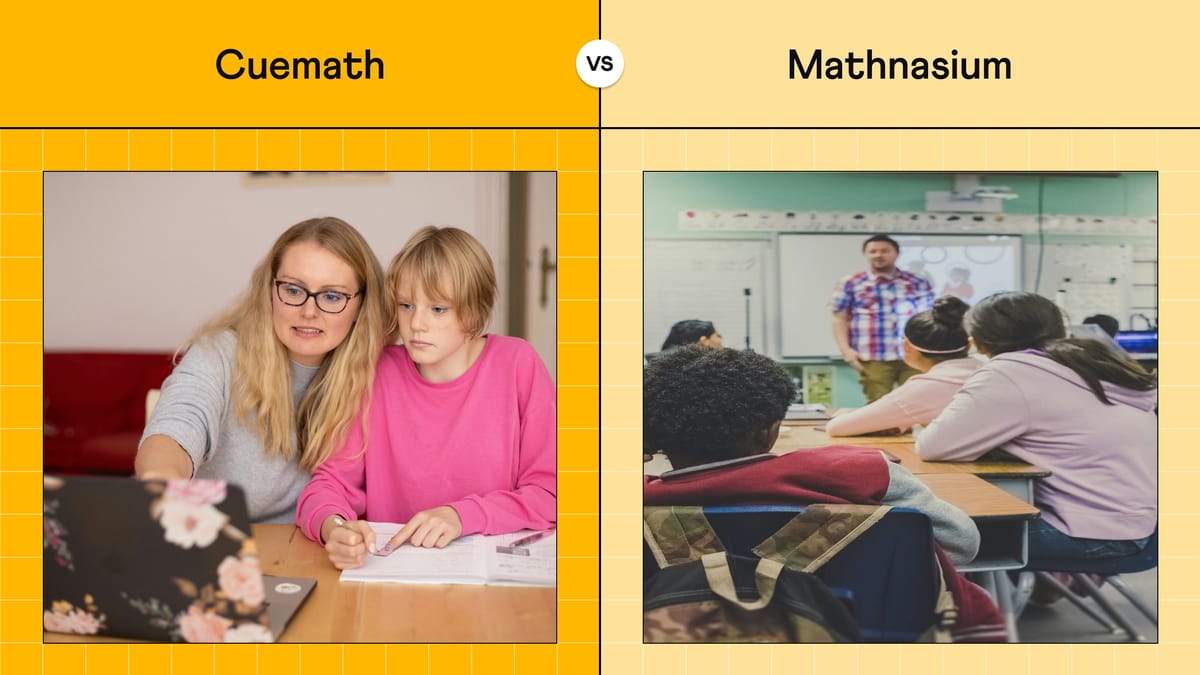
Cuemath and Mathnasium are two popular after-school math tutoring programs in the US. While at the surface, these programs look very similar, their tutoring styles are very different.
In this blog, we compare Cuemath and Mathnasium on the basis of teaching format, pricing, tutor consistency, curriculum alignment, and what parents in the US actually report. We reviewed Trustpilot data, parent discussions in online communities, and official website data for both platforms.
Quick Answer: Cuemath vs Mathnasium: Which is Better?
For parents who are aware of both of the platforms and want a quick answer based on their child's goal and overall convenience:
How Did We Review Cuemath and Mathnasium?
Besides the official website data, we reviewed the following:
- Trustpilot reviews and individual reviews: We understand that in some cases, there are a lot of false negative reviews out there, so those were not taken into making a firm judgement.
- Reviews and opinions of parents or students who have tried either of the platforms and shared their thoughts on Reddit.
Cuemath Review
When parents evaluate a math program, they’re not looking for a feature list; they’re asking specific questions about their child. We’ve structured this review around the five questions parents ask most.
Cuemath is a live 1:1 online math tutoring platform for K–12 students. Every class runs on a proprietary collaborative whiteboard called the Cueboard, with the same dedicated tutor assigned to your child for every session.
Does Cuemath assign the same tutor every class?
Yes, Cuemath pairs each student with one dedicated tutor. The tutor gets to know how your child thinks, where they hesitate, and what motivates them, rather than starting fresh each session. Cuemath selects math tutors who have over 5-10+ years of teaching experience, and trains each one in math pedagogy and child psychology.
Is Cuemath’s curriculum aligned with what my child learns in school?
Yes, Cuemath maps its curriculum directly to Common Core State Standards (CCSS), so classes reinforce what’s happening in school, not a separate track your child has to mentally context-switch between.
How does Cuemath personalize learning for each student?
Every student starts with a MathFit evaluation, a full assessment that identifies exactly where gaps exist and where the student is ahead. The tutor builds a learning plan around that child’s specific learning needs and goals, so it is a targeted math tutoring, not a generic one.
How does Cuemath keep kids engaged in online math classes?
Classes happen on the Cueboard, a live collaborative whiteboard where the tutor and student solve problems together in real time. Because the same tutor shows up every week, students build the kind of relationship that reduces math anxiety and sustains effort. More than 80% of Cuemath’s reviews on Trustpilot are five stars, with the majority by parents describing a shift in their child’s attitude toward math, not just grade improvement.
How does Cuemath measure student progress?
Every month, students take a MathFit Assessment, scored across four areas: Fluency, Understanding, Application, and Reasoning. Parents receive a specific score, not a vague status update. You can see where your child grew and where they still need work, month by month, with the same rubric each time.
Achievments of Cuemath Students
From SAT scores to Math Olympiads, what consistent 1:1 tutoring builds.
With Cuemath's 1:1 tutoring, Bryan built logic and confidence — now he has aced high-school algebra and ranked #9 nationally in Math Kangaroo.
Cuemath strengthened Aadi's step-by-step thinking — turning raw talent into 99th percentile AMC success and consistent top scores.
Cuemath strengthened her mental math and stepwise logic. Nivriti improved calculation speed, concepts, and accuracy under Olympiad pressure.
Cuemath turned math anxiety into mastery — helping Harshitha excel in AP Calculus, skip college Calc I, and enter a top U.S. business school.
With Cuemath's logic-first tutoring and consistent practice, Midyan achieved a 1520 SAT and 790/800 in Math on his first attempt.
Cuemath's guided practice and US-aligned curriculum shaped Vanya's reasoning, leading her to ace AP Calculus BC and score a 1530 in SAT.
One limitation to know: Cuemath is currently fully online for the US. Students who need a social environment or people around may not find it the right fit. The Cuemath Free Trial, one full 1:1 class plus the MathFit evaluation, no credit card required, is the fastest way to find out before you commit.
Best for: K–12 students who learn well 1:1 online and whose parents want school-aligned curriculum, a consistent tutor relationship, and measurable monthly progress.
Not for: Students who need in-person instruction, or families specifically looking for a peer learning environment.
See What a Real 1:1 Math Class Looks Like
Try a free live Cuemath class, a 1:1 session with an expert tutor & personalized learning plan. Easy scheduling and refunds.
Book a Free ClassFor Students in Grades K to 12
Mathnasium Review
We applied the same parent-first lens to Mathnasium, the same five questions, answered directly, so you can compare apples to apples.
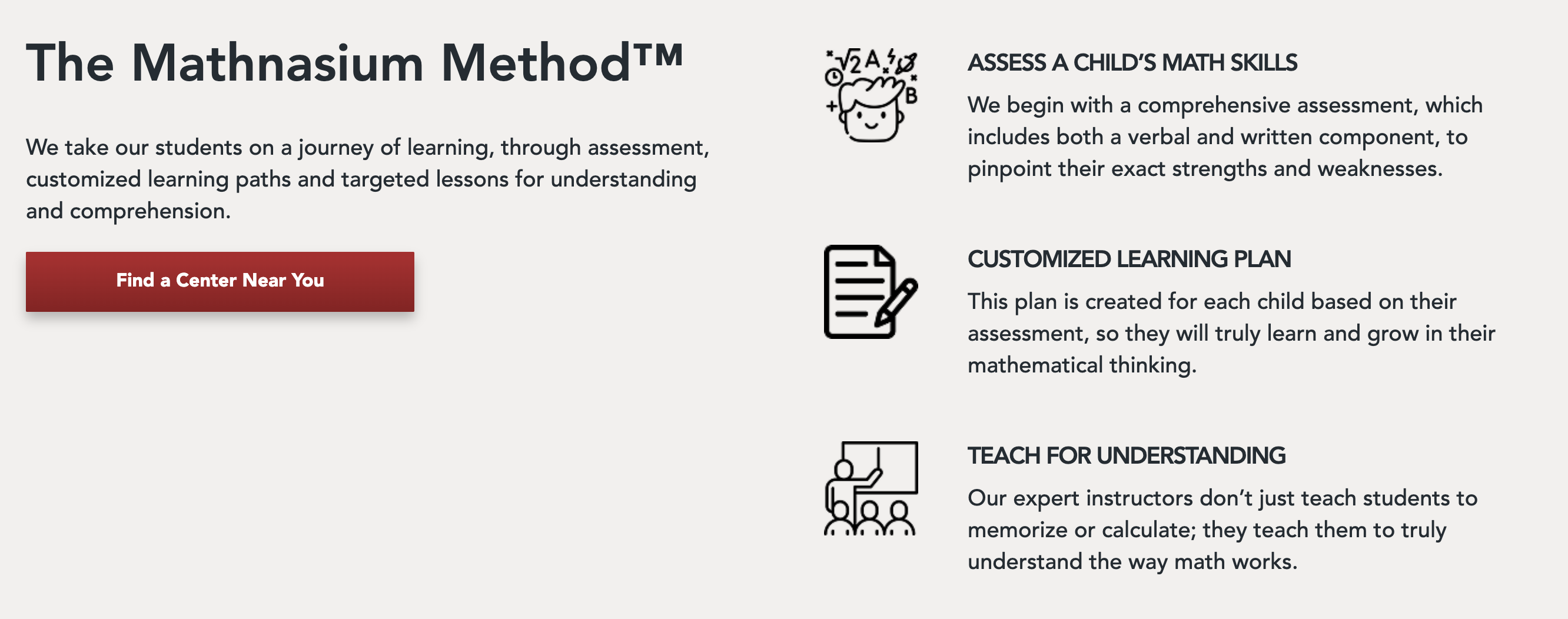
Mathnasium is a franchise-based in-person math tutoring center operating at 1,000+ locations across the US, using a small-group instruction model and a proprietary worksheet-based curriculum called the Mathnasium Method.
Visit the Official Website of MathnasiumDoes Mathnasium assign a dedicated tutor to my child?
No, Mathnasium uses a shared-instructor model where one instructor works with up to four students at the same time.
Is Mathnasium’s curriculum aligned with school coursework?
Not explicitly, Mathnasium uses a proprietary curriculum called the Mathnasium Method, which is not labeled as CCSS-aligned. The method is built around foundational arithmetic and number sense, effective for closing basic gaps, but not designed to track alongside what a student is doing in school.
How does Mathnasium personalize learning for each student?
Mathnasium starts with an initial assessment to identify where a student stands. From there, students work through a structured sequence of worksheets at their own pace. Personalization is primarily pacing-based; students move faster or slower through the same content sequence.
Will my child stay engaged at Mathnasium?
For students who benefit from being physically in a dedicated learning space, the in-person center environment can build routine and consistency. Parents in online communities note that Mathnasium feels less stressful than Kumon, and instructors are encouraged to be supportive rather than corrective.
How does Mathnasium measure progress?
Mathnasium does not publish a standardized monthly progress report. Progress tracking varies by center. Parents report receiving general updates from instructors, but specific, scored assessments on defined skill dimensions are not a standard part of the Mathnasium model.
What should parents know about Mathnasium’s billing and consistency?
Mathnasium centers are independently owned franchises, so quality, pricing, and billing practices vary significantly by location. 25% of Mathnasium’s Trustpilot reviews are 1-star, with several citing unexpected price increases and unresponsive management. Before enrolling, parents are advised to confirm the specific center’s policies in writing.
Best for: Students in K–8 with foundational arithmetic gaps who learn well in person and have access to a consistently well-run Mathnasium center nearby.
Not for: High school students (limited curriculum above Algebra II), students who need 1:1 attention, or families without a reliable Mathnasium center in their area.
Cuemath vs Mathnasium: Which is Better by Grade Level?
Use this section to quickly analyze both platforms based on grade level.
Which program is better for Kindergarten (Age 5–6)?
Cuemath is the stronger pick for kindergarteners. At this age, undivided adult attention matters most, and Mathnasium’s shared-instructor model doesn’t provide it.
- Cuemath: One tutor, one child, 55–60 minutes of full attention. The Cueboard makes abstract early concepts, counting, patterns, basic addition, visual, and interactive. Tutors are trained in child psychology, not just math.
- Mathnasium: A kindergartener shares instructor time with up to three other children. Five-year-olds who are still building focus and patience can struggle in this format.
Which program is better for Elementary School (Grades 1–5)?
It depends on the goal. This is the one grade band where both programs are genuinely competitive.
- Choose Mathnasium if: Your child has significant gaps in foundational arithmetic, number sense, multiplication tables, and basic fractions. The worksheet-drill approach closes these gaps efficiently.
- Choose Cuemath if: Your child is on grade level or above and needs conceptual depth alongside procedural fluency. Cuemath's focus is on “why it works” to “how to solve it”, preparation for the reasoning-heavy problems that appear in middle school.
Which program is better for Middle School (Grades 6–8)?
Cuemath is the better choice for middle school. This is where the gap between a conceptual program and a procedural one becomes most visible.
- Cuemath: The MathFit framework explicitly tracks Reasoning and Application, the skills tested in state assessments and middle school math competitions. Strong fit for pre-algebra, algebra, and honors prep.
- Mathnasium: Curriculum thins out at this level. The worksheet model is less suited to the multi-step reasoning that algebra and geometry require.
Which program is better for High School (Grades 9–12)?
Cuemath. This is not a close comparison. Mathnasium’s curriculum has documented limitations above Algebra II.
- Cuemath: Covers the full K–12 curriculum, Precalculus, Algebra I, Algebra II, AP Calculus, and SAT Math prep. Same 1:1 tutor throughout, with MathFit assessments calibrated to the student’s level.
- Mathnasium: Built around foundational and intermediate math. Parents who have tried to enroll high schoolers for advanced content report being redirected or told the center has limited capacity for that material.
Cuemath vs Mathnasium Comparison Table
Ready to Try the Program 200K+ Students Trust?
Book your child's free Cuemath class, a full 60-minute 1:1 class with a free MathFit assessment to identify gaps included.
Book a Free ClassFor Students in Grades K to 12
Frequently Asked Questions
Is Cuemath better than Mathnasium?
Cuemath and Mathnasium serve different students. Cuemath is stronger for live 1:1 tutoring, consistent tutor relationships, high school math, measurable monthly progress, and online flexibility. Mathnasium is stronger for K–8 students who need foundational gap-closing in an in-person environment. For most US families, especially those with middle school or high school students, Cuemath covers a broader range of needs.
What is the main difference between Cuemath and Mathnasium?
The core difference between Cuemath and Mathnasium is format and attention, model. Cuemath delivers live 1:1 online classes where one tutor works with one student for the entire class. Mathnasium operates in-person franchise centers where one instructor works with up to four students simultaneously. Cuemath's curriculum is CCSS-aligned; Mathnasium uses a proprietary worksheet-based system called the Mathnasium Method that does not explicitly align to Common Core standards.
How much does Mathnasium cost per month?
Mathnasium pricing is not publicly listed and varies by center. Most Mathnasium centers charge approximately $150–$300/month, though individual session prices of up to $100 have been reported by parents on Trustpilot. Billing practices vary by franchise location. Always request pricing in writing before enrolling and ask whether a contract is required.
How much does Cuemath cost per month?
Cuemath pricing varies by plan and grade level. On average, it starts with $20 per class. The clearest starting point is the free trial, one full 60-minute 1:1 class plus a MathFit assessment, with no credit card required. Check the Cuemath pricing page for current US plan pricing specific to your child's grade.
Is Mathnasium good for high school students?
Mathnasium is not recommended for high school students above Algebra I. The Mathnasium Method is built around foundational and intermediate math. Students who need Precalculus, Trigonometry, AP Calculus, or SAT Math preparation are better served by a platform with a full K–12 curriculum.
Does Mathnasium help with school homework?
Mathnasium's curriculum follows the proprietary Mathnasium Method rather than CCSS or school curriculum. It focuses on building foundational number sense through worksheets, not reinforcing specific school assignments. Cuemath's CCSS-aligned curriculum maps more directly to what US students are actively learning at school and is the stronger choice if school-homework reinforcement is the goal.
Is Mathnasium worth it?
Mathnasium works well for some families, specifically those with K–8 students near a well-run center who benefit from in-person worksheet-based instruction. However, 25% of Mathnasium's Trustpilot reviews are 1-star, frequently citing billing disputes, inconsistent instructor quality due to high turnover, and limited curriculum depth. Value depends heavily on the individual franchise center. Before enrolling, ask specifically how long the current instructors have been at that center.
Which is better for a struggling student: Cuemath or Mathnasium?
For students who are below grade level in K–8, Mathnasium's structured worksheet-based drill can close foundational gaps. For students struggling with conceptual understanding, algebra, or multi-step reasoning, Cuemath's 1:1 tutor model is more effective because a live tutor can identify the specific misconception and address it directly, rather than repeating practice problems until performance improves by volume.
Does Cuemath improve math grades?
Cuemath measures student progress monthly through MathFit Assessments, scored on Fluency, Understanding, Application, and Reasoning. Students receive a specific score on a 3–10 scale each month. Cuemath has 9,500+ Trustpilot reviews at 4.9/5 as of March 2026, with many parents citing grade improvements and increased math confidence.
What do parents say about Mathnasium on Reddit?
Parents in r/Kumon and r/mathteachers communities report that Mathnasium instructors are paid approximately $10–$25/hour, contributing to high turnover and inconsistent instructor relationships. Some parents switched from Kumon to Mathnasium because their children were stressed under Kumon's strict repetition model, finding Mathnasium gentler. The shared instructor model (1:4 ratio) and franchise inconsistency remain the most common concerns. (Source: r/mathteachers, r/Kumon, February–March 2026)
Does Cuemath work for homeschool families?
Cuemath is used by homeschool families in the US because the online 1:1 format fits easily into homeschool schedules, and the CCSS-aligned curriculum provides structured math instruction without requiring a separate school enrollment. The monthly MathFit Assessment gives homeschool parents a specific, measurable progress benchmark that replaces school-issued grades.
Is Mathnasium's curriculum aligned to Common Core?
Mathnasium's curriculum is based on the Mathnasium Method, a proprietary system, and is not marketed as CCSS-aligned. Mathnasium does not explicitly map its worksheet content to Common Core standards. Cuemath explicitly aligns its full K–12 curriculum to CCSS, making it the stronger choice for parents who want after-school tutoring to reinforce school-aligned math instruction.
Sources
- NAEP 2022 Mathematics Assessment — National Center for Education Statistics
- Mathnasium Trustpilot Reviews — verified March 2026
- Cuemath Trustpilot Reviews — 4.9/5 from 9,667+ reviews, verified March 18, 2026
- Common Core State Standards for Mathematics — corestandards.org
- Evidence for ESSA — math program research database, Johns Hopkins University