How to Study for the SAT: Complete Guide for Every Timeline
Whether you have 6 months or 6 days, this guide breaks down exactly how to study for the SAT, what to focus on, what to skip, and how to perform at the ceiling of what you already know.

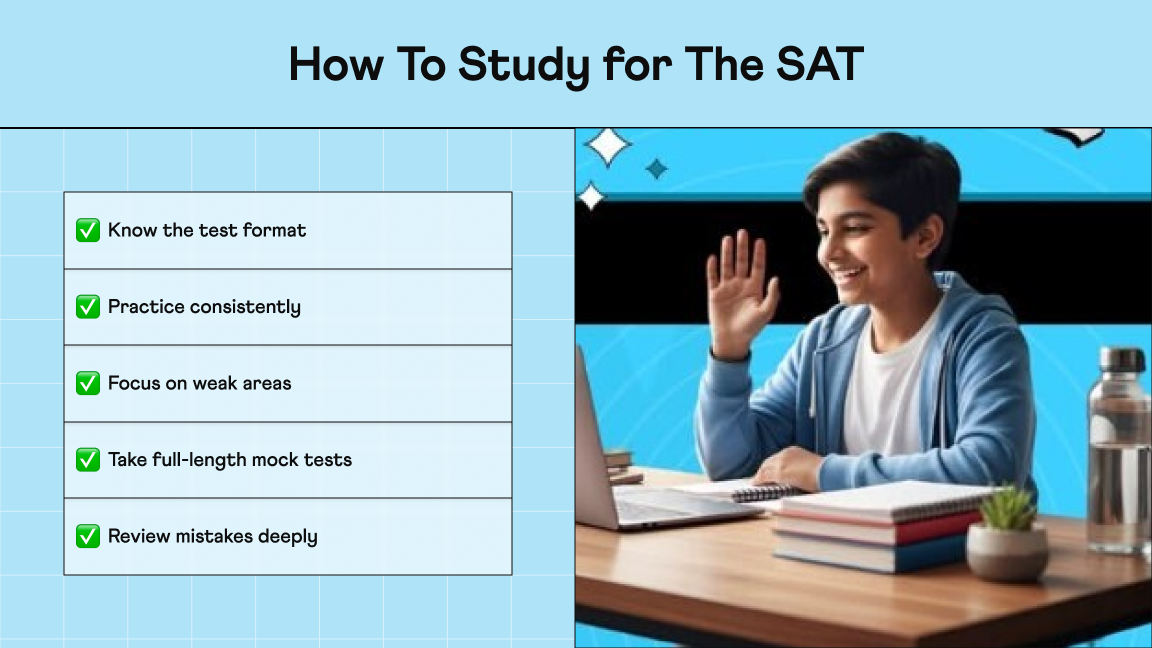
To study for the SAT, take a free Bluebook practice test to get your baseline score. Identify your two weakest areas—focus on specific question types, not just “Math” or “Reading.” Study consistently for 45–60 minutes a day using targeted official SAT practice. Take another full-length test after 4–6 weeks to measure improvement, and repeat this cycle until test day. Most students need about 20–40 hours for a ~100-point gain and 40–80 hours for a ~200-point gain.
Last updated: March 2026
The SAT is now fully digital and knowing how to study for the digital SAT in 2026 means preparing for a test that has fundamentally changed.
Since March 2024, every student takes the Digital SAT on the Bluebook app: a 2-hour 14-minute, computer-adaptive exam where Module 2 difficulty adjusts based on how well you perform in Module 1. There is no paper option, no separate no-calculator section, and no penalty for wrong answers.
This guide covers everything you need: a study plan matched to your exact timeline, whether you have 6 months or 72 hours, plus section strategies, the best free resources, and what actually moves your score in the Digital SAT format.
Table of Contents
- Understanding the 2026 Digital SAT Format
- How to Study for the SAT: Choose Your Timeline
- How to Study for the SAT with 6 Months (Ideal Timeline)
- How to Study for the SAT in 3 Months
- How to Study for the SAT in 1 Month
- How to Study for the SAT in 72 Hours
- Which SAT Math Topics Should You Study?
- How to Ace the SAT Reading & Writing Section Without Reading Everything
- What Are the Best Resources to Study for the SAT?
- The Bottom Line: How to Study for the Digital SAT (2026)
- Frequently Asked Questions
Understanding the 2026 Digital SAT Format
Before building your study plan, understand what you're preparing for. The Digital SAT is shorter, adaptive, and strategy-driven—knowing the format helps you prepare smarter.
BASED ON PERFORMANCE
+ MATH
ON ALL MATH QUESTIONS
ATTEMPT ALL QUESTIONS
For a full breakdown of Digital SAT format, question types, and scoring mechanics, read our 10 expert SAT strategies guide.
How to Study for the SAT: Choose Your Timeline
The right study plan depends entirely on how much time you have. Pick your timeline below and follow it precisely, trying to follow a 6-month plan when you have 3 weeks is a fast path to burnout and wasted sessions.
How to Study for the SAT with 6 Months (Ideal Timeline)
Six months is the ideal SAT study timeline, enough time to improve by 150–200+ points through consistent, structured weekly practice rather than cramming.
- Weeks 1–2: Take a full-length Bluebook practice test (free). Score it. Identify your two weakest question types in each section, be specific (e.g. "systems of equations" not just "Math").
- Weeks 3–8: Study 45–60 minutes/day, 4–5 days per week. Use Khan Academy Official SAT Practice, which personalizes questions to your specific gaps. Focus entirely on your weak areas — do not review topics you already know.
- Weeks 9–16: Add timed section practice. Complete one full section per study session under real conditions (no pausing, no phone). Review every wrong answer before moving on. Keep an error log: write down why you got each question wrong.
- Weeks 17–22: Take a second full Bluebook practice test. Compare your score to your baseline. Adjust your focus based on what's still weak — not what you feel like studying.
- Weeks 23–24: Final phase. Take a full practice test every 10 days. Light review only in the last week. No new content the night before.
In the end, strong SAT scores come from clear concepts and consistent practice. Learning environments that emphasize understanding over memorization—like Cuemath—can help students build the kind of problem-solving skills the Digital SAT rewards.
Instead of treating it as an add-on, Cuemath includes SAT prep within its high school math courses, covering relevant concepts, question types, and test strategies as part of regular learning.
A 1500 SAT Score isn’t luck. It’s a strategy.
Get a targeted SAT prep plan with expert tutors at Cuemath through personalized 1:1 online math classes for high school.
How to Study for the SAT in 3 Months
Three months is enough for a meaningful score improvement — typically 80–150 points, if you go straight to your weakest areas rather than reviewing everything from scratch.
- Week 1: Take a Bluebook practice test. Identify the 2–3 question types costing you the most points. This is your entire focus for the next 11 weeks.
- Weeks 2–6: Study 1 hour/day, 5 days/week. Drill those specific question types using Khan Academy. Do not touch topics you are already scoring well on — it feels productive and isn't.
- Weeks 7–9: Shift to timed practice. Simulate real test conditions — one full section per session minimum. Time yourself strictly. Review every miss immediately after.
- Week 10: Take a second full Bluebook practice test. Review every wrong answer. Note any new weak areas that have emerged.
- Weeks 11–12: Final push. Alternate between timed section practice and targeted drilling of any remaining weak spots. Rest 2 full days before the exam.
How to Study for the SAT in 1 Month
One month is tight but absolutely enough to improve your score — provided you focus on your single biggest weakness rather than trying to review every topic. Breadth is the enemy here.
- Days 1–3: Take a full Bluebook practice test. Score it. Identify your one highest-leverage weakness — one question type, one concept area. That is your only target for the next 4 weeks.
- Days 4–10: Study 90 minutes/day. Drill that one weakness obsessively using Khan Academy. Untimed practice first (accuracy), then timed (speed). Don't move on until your accuracy on that question type is above 80%.
- Days 11–17: Add timed full-section practice. One full section every other day. Review every wrong answer the same day — don't let errors sit overnight.
- Days 18–25: Take a second full Bluebook practice test. Identify what is now your second biggest weakness. Switch focus to that.
- Days 26–29: Light review only. Go through your error log. Skim key formulas and grammar rules you've noted. No new material.
- Day 30 (night before): Pack your bag, charge your device, review your formula sheet for 10 minutes, sleep 8 hours. That's it.
A 50-point gain in one section is far more achievable than a 25-point gain in both.
How to Study for the SAT in 72 Hours
With 3 days left: Day 1: timed half-test + error triage. Day 2: drill your top 2 weak spots only. Day 3 (night before): zero new studying, focus on logistics and sleep. This structured approach consistently outperforms random cramming.
Think of your final 72 hours as three distinct phases, each with a different job. Mixing them up is how students waste precious time.
72HRS OUT
48HRS OUT
12HRS OUT
Related Article: 10 SAT Prep Tips to Boost Your Score
Which SAT Math Topics Should You Study?
For SAT math prep, focus on linear equations, systems of equations, percentages, ratios, and function notation. These five areas cover most SAT Math questions. Memorize the 10 core formulas, and skip trigonometry and advanced geometry; they are low-frequency and time-consuming.
SAT Math doesn't test your full calculus knowledge. It's testing a narrow, highly repeatable set of algebraic and data-reasoning skills. When you have limited time, this is actually good news.
| Topic | Approx. Frequency | Last-Minute Priority |
|---|---|---|
| Linear equations & systems | High | 🔴 Must drill |
| Percentages, ratios & rates | High | 🔴 Must drill |
| Function notation & transformations | Medium-High | 🟠 Review concepts |
| Quadratic equations | Medium | 🟠 Know standard form |
| Statistics & data interpretation | Medium | 🟡 Skim graphs quickly |
| Geometry (area, volume, angles) | Low-Medium | 🟢 Formula sheet only |
| Trigonometry | Low | ⚪ Skip if pressed |
The 10 SAT Math Formulas Worth Memorizing Right Now
The Digital SAT provides a reference sheet, but spending test time looking things up kills your pacing. Know these cold:
- → Slope formula: (y₂ – y₁) / (x₂ – x₁)
- → Slope-intercept form: y = mx + b
- → Quadratic formula: x = [–b ± √(b²–4ac)] / 2a
- → Percent change: [(new – old) / old] × 100
- → Distance = Rate × Time
- → Average = Sum of terms / Number of terms
- → Area of triangle = ½ × base × height
- → Pythagorean theorem: a² + b² = c²
- → Circumference of circle: 2πr
- → Exponential growth: y = a(1 + r)t
The One SAT Strategy in Math Section That Actually Saves Time
For every Math question, before you solve it, ask: "Can I plug in numbers instead of solving algebraically?" For questions with variables in the answer choices, plugging in a simple number (like x = 2) lets you test answers directly. This technique alone can save 30–60 seconds per question, which at scale means finishing with time to check your work.
Find what’s dropping your SAT score.
Cuemath’s 1:1 online classes identify algebra gaps, careless mistakes, and time pressure, then fix them with focused, personalized practice.
Not one-size-fits-all courses.
 Cuemath
How to Ace the SAT Reading & Writing Section Without Reading Everything
For SAT Reading & Writing, read the question before the passage. Each passage is short and tied to one question, so focus on what’s being asked first, then skim for the exact evidence. Keep your pace tight — don’t spend more than 75 seconds per question.
The 4 Question Types That Repeat Most Often:
| Question Type | What It's Really Asking | Fast Strategy |
|---|---|---|
| Words in Context | Which word fits the passage's meaning here? | Read the sentence, cover the blank, predict your own word, then match |
| Central Idea / Purpose | What is this passage mainly doing? | Read first and last sentence of each paragraph only |
| Command of Evidence | Which quote supports a given claim? | The answer must directly prove the claim, not just "relate to" it |
| Grammar / Transitions | Which sentence connector fits here? | Know your 3 categories: contrast (however, although), continuation (furthermore, also), conclusion (therefore, thus) |
What Are the Best Resources to Study for the SAT?
Here are the top three free resources, used correctly, are everything most students need.
1. Bluebook (College Board)
The official Digital SAT practice platform. Four full-length adaptive tests, free, at bluebook.collegeboard.org. This is the closest simulation to the real exam — same interface, same adaptive format, same question style. Take every practice test here, not on third-party platforms.
2. Khan Academy Official SAT Practice
Built in direct partnership with College Board. It personalizes practice questions to your specific score gaps using your PSAT or SAT scores. Includes video explanations for every question type. Free at khanacademy.org/test-prep/digital-sat.
3. Desmos graphing calculator
The exact calculator built into Bluebook for all Math questions. Practice with it at desmos.com/scientific before test day — the interface takes getting used to, and learning it during the real test costs points.
If your math foundations have gaps, Cuemath is worth serious consideration.
The SAT doesn't test memorized formulas — it tests whether you actually understand how math works. If algebra, functions, or geometry feel shaky, no amount of practice tests will fix that. You'll keep missing the same questions, just on different problems. That's the ceiling that foundation gaps create.
Cuemath is built specifically for this situation. You start with a free diagnostic that identifies exactly where your understanding breaks down not just which topics, but which concepts within those topics.
From there, an expert 1-on-1 tutor builds a personalized plan around your specific gaps, not a generic curriculum. Every session is live, interactive, and adapted to how you learn.
Explore the Highschool math courses in Cuemath
Your next SAT date isn't moving.
Start with the free trial class and know exactly what to fix.
 Cuemath
The Bottom Line: How to Study for the Digital SAT (2026)
The Digital SAT is shorter, adaptive, and more strategy-driven than the old exam—so your preparation needs to be focused, consistent, and targeted.
Start with a Bluebook practice test to establish your baseline, then identify your specific weak question types. Study for 45–60 minutes daily using official resources like Khan Academy, and prioritize reviewing mistakes over doing more questions.
Your study plan should match your timeline:
- 6 months: Build concepts + steady improvement (150–200+ points possible)
- 3 months: Focus on top weak areas + timed practice
- 1 month: Target one high-impact weakness for quick gains
- 1 week: No new learning—focus on accuracy, patterns, and rest
For Math, concentrate on high-frequency topics like algebra and data analysis, and use strategies like plugging in values to save time. For Reading & Writing, master common question types and pacing (≤75 seconds per question).
You don’t need expensive prep: Bluebook + Khan Academy are enough for most students. At the same time, structured programs like Cuemath integrate SAT-style problem solving into high school math, helping students build strong fundamentals while preparing for the test.

Frequently Asked Questions
How do I study for the SAT in 3 days or less?
Stop learning new material entirely. Day 1: take a half-length Bluebook practice test and log every error by type. Day 2: drill only your top 2 weak areas:20 questions untimed, then 10 timed. Night before: review the formula sheet for 10 minutes, then sleep. The goal isn't to learn the SAT in 72 hours; it's to perform at the ceiling of what you already know.
What are the most important SAT prep tips for last-minute students?
The highest-impact SAT prep tips when time is short: (1) prioritize Module 1 accuracy over speed — your Module 2 difficulty depends on it. (2) Never leave a blank — the Digital SAT has zero penalty for wrong answers. (3) For math, plug in numbers before solving algebraically. (4) For Reading & Writing, read the question before the passage. (5) Geometry is low-frequency; skip it if you're stuck and come back.
Is it possible to raise your SAT score overnight?
Strategy-level improvement? Absolutely yes. Content-level improvement? Unlikely in one night. Most students who report surprising score jumps did the same thing: they fixed timing mistakes, stopped leaving blanks, and got a full night's sleep. Students who cram new concepts overnight almost always perform worse than their practice average.
How do I study for SAT Math last minute when algebra is my weak spot?
Focus on linear equations and systems of equations; these are the highest-frequency algebra topics on the Digital SAT. Practice 15–20 questions in untimed mode first to rebuild confidence, then time yourself. Use the plug-in method (substitute x = 2) for questions with variables in the answer choices. If you want a faster recovery than self-study allows, platforms like Cuemath offer 1:1 SAT Math tutoring that's specifically built around identifying and closing these exact gaps.
What does "how to ace the SAT" actually mean when you have one week left?
With one week left, acing the SAT means something specific: maximizing your score within what you already know. Build your error log from a practice test, rank your mistakes by frequency, drill those categories daily for 4 days, take a timed full section on Day 5, rest on Day 6, and execute on Day 7. "Acing" at this stage is about precision, not volume.
Should I pull an all-nighter before the SAT?
No, and this isn't just conventional wisdom. Sleep is when your brain consolidates studied material into retrievable long-term memory. A student who sleeps 8 hours after a light review will measurably outperform one who studied 3 extra hours but slept 5. If you have to choose between one more hour of cramming and one more hour of sleep, always take the sleep.
What are the best free resources to study for the SAT right now?
The Bluebook app (College Board's official digital testing platform) is the single most important free tool; its full-length adaptive tests are the closest simulation to the real thing. Khan Academy's SAT practice is a strong second for targeted question drilling. For students who want structured guidance on top of free resources, Cuemath's SAT Math prep pairs 1:1 tutoring with targeted Digital SAT-style practice, useful if self-study isn't moving the needle fast enough.
How do I stop running out of time on the Digital SAT 2026?
Time management on the Digital SAT is largely a triage problem. Set a personal rule: if a question takes more than 90 seconds, flag it and move on; collect every "easy" point first. For Reading & Writing, never spend more than 75 seconds per question. For Math, the plug-in method and Desmos calculator together eliminate most slow, algebraic dead ends. Practice this approach on at least one timed section before test day so it becomes automatic.
Does the "Words in Context" question on the Digital SAT require strong vocabulary?
Less than you would think. As students on r/SAT consistently note, these questions are logic puzzles, not vocabulary quizzes. The correct answer must match the precise meaning required by the sentence's context, not just sound sophisticated. The strategy: isolate the sentence, cover the blank, predict your own word, then match to the answer choices. This works even when you don't know the words offered.
Is it worth retaking the SAT if this sitting doesn't go well?
Yes; and use this attempt strategically even if it doesn't go as planned. Many colleges accept Score Choice, meaning you submit only your best result. Treat this sitting as a real-condition diagnostic: note exactly which question types cost you time, which concepts you blanked on, and how Module 2 felt. That data is worth more than any practice test for building your next prep plan. If you want structured support for a retake, programs like Cuemath's 1:1 SAT Math tutoring are specifically designed to close individual score gaps between attempts.
How is studying for the Digital SAT different from the old paper SAT?
Three key differences matter for last-minute prep. First, the format is adaptive: your Module 1 performance determines the difficulty of Module 2, so early accuracy is more valuable than ever. Second, passages in Reading & Writing are short (50–150 words), each paired with one question; the old "read the whole passage" approach wastes time. Third, you have a built-in Desmos graphing calculator for all Math questions; learn to use it before test day, not during.

About the Author
Neelima Kotamaju
Neelima Kotamraju is an Educator with 10+ years in EdTech, designing learning experiences rooted in pedagogy, classroom insights, and child psychology.
View My LinkedIn